
Search
2026 05 04 Green Bridge from Stackpole Quay

2026 05 04 Pembroke Bank Holiday Trip – Green Bridge from Stackpole Quay
We saved the best trip for the last day. All 11 paddlers were on the water again today; nobody had bailed, stayed in bed or declared that they were too tired to paddle, and this had led to a sense of camaraderie. We had cleared the accommodation at the Kestrel Bunkhouse at Stackpole, as we had to be out by 10:00 am. We left it spotless, with the non- paddlers left to leave it secure. We headed down to Stockpole Quay and unloaded our boats into the small sheltered harbour.
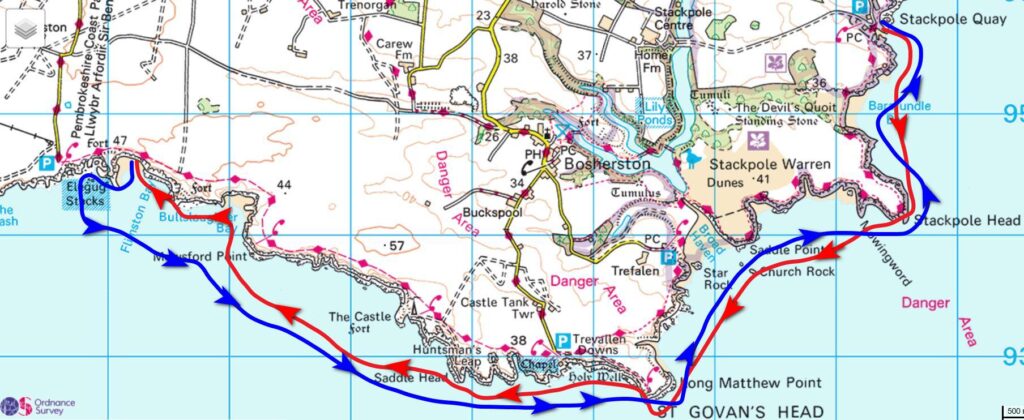
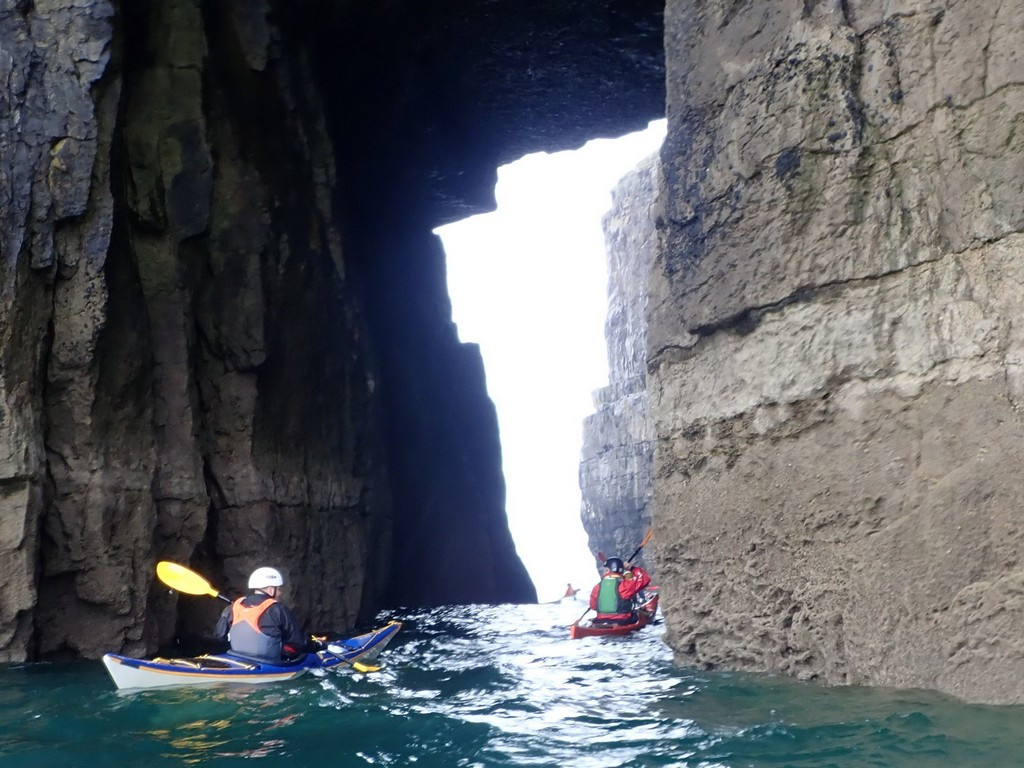
Once on the water, we headed off into a misty sea with a strange easterly airflow producing a small chop. At Stackpole Head, we found several square arches, which were not unlike the ones we found on Menorca. We all paddled through, and then some paddled back around the head to have a second go. Several prospective sea leaders took it in turns to lead the group. We headed across to Church Rock and then St Govan`s Head, where some members had walked to last night. The tide was still ebbing and pushed us along with a couple of knots of assistance.
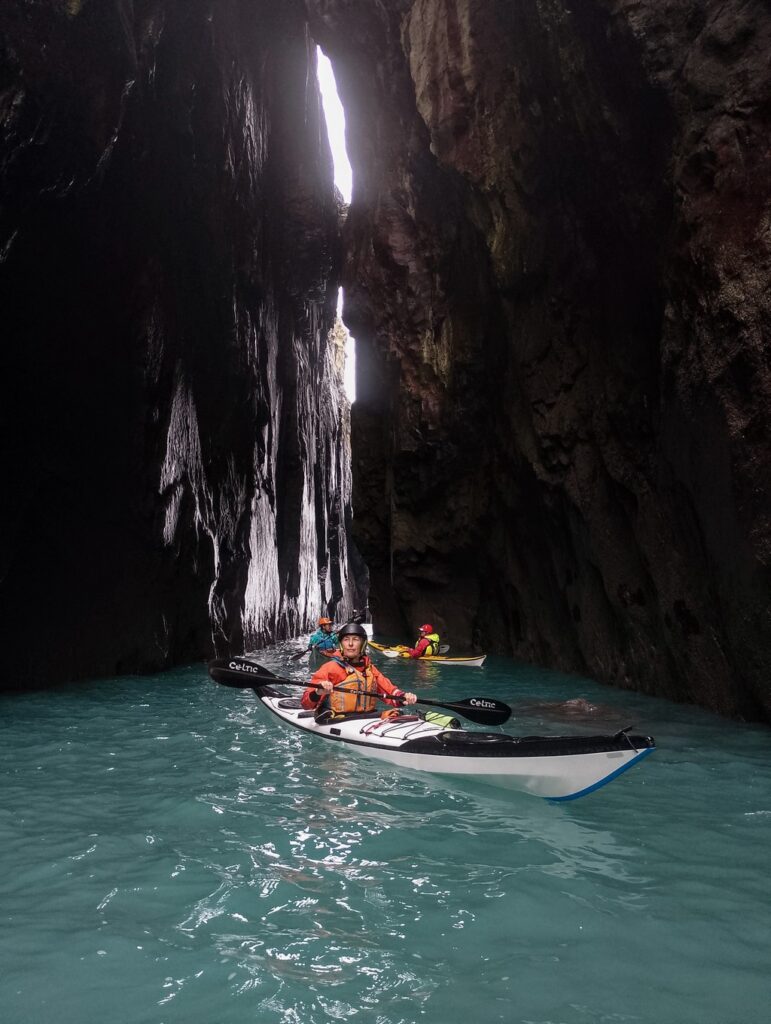
Saddle Head beckoned in the distance, and we discussed exactly what sort of saddle it was. In the end, it was 50:50 between English and Western style. We had been anxious to explore the many caves, but with a 20km paddle to make, we had to leave many until the return part of the journey. At Saddle Head, there was a narrow cleft in the rocks which had to be explored. It was large enough for all 11 of us to explore to the back. This was Hunsmans Leap.
Huntsman’s Leap is a deep, narrow and sheer-sided coastal chasm or geo developed in the Carboniferous Limestone of the Pembrokeshire Coast National Park, Pembrokeshire, Wales. The name derives from local folklore, a hunter on horseback, being chased by the devil, is said to have jumped from one side of the chasm to the other. On looking back and seeing the gap that he had jumped, he died of shock.
By now it was time for eleveneses, but we were not even sure we would be able to land. The first of the two possible bays looked far too rocky with a small swell breaking on them. At the second, just under Eiegu Stacks, a small patch of sand began to form as the tide dropped. We took the opportunity for a short break.
On leaving the beach, a tourist shouted down from the cliff that there were a couple of lambs that had fallen from the cliffs above. Landing would have been very difficult, to say the least, and we would have been unable to transport either of them, even if they could have been caught. This really was an exposed part of the coastline.
We paddled over to the Green Bridge of Wales, A large natural arch with green grass over the top of it. On the approach, we noticed thousands of seabirds nesting on the two stacks before it and the one after it. We kept away as we did not want to cause them all to take flight at once. Staying 100m out seemed to work, and most did not even notice us. We took a few photos and then left by heading straight offshore. This put a little distance between the colonies of razorbills and guillemots and us. It also meant that we started to catch more of the now flooding tide.
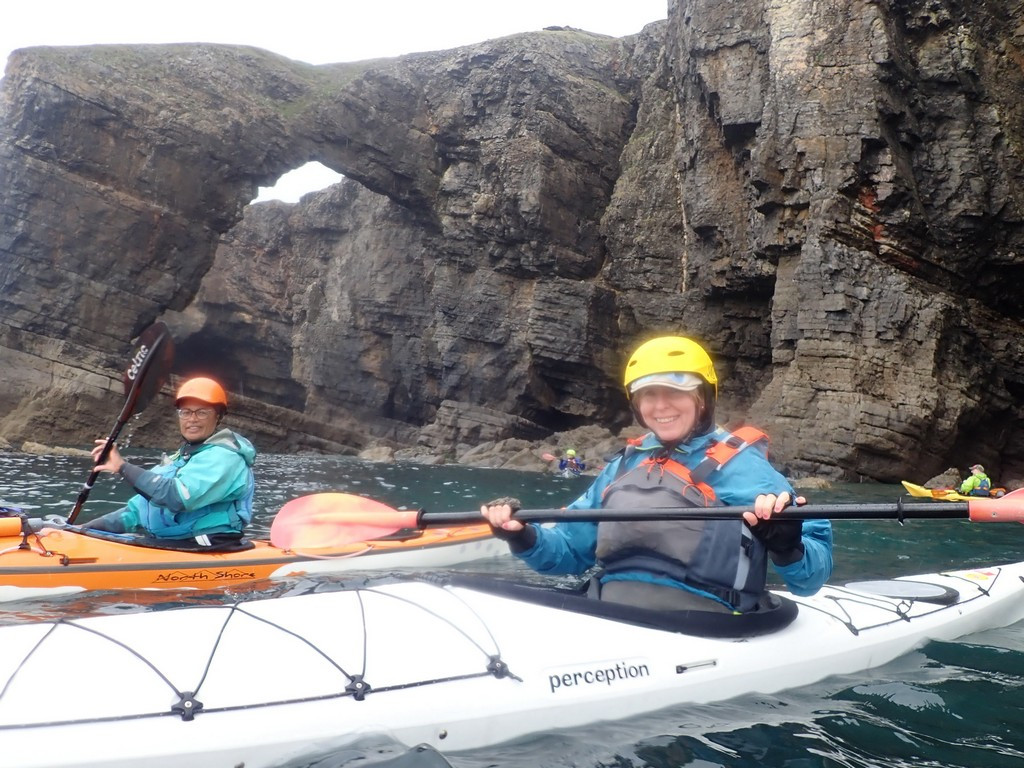
The Green Bridge of Wales is a 24m (80ft) high natural limestone arch located on the southern coastline of Pembrokeshire Coast National Park. The Bridge spans more than 20m (66 ft) with its outer edge resting on a more durable rock pedestal. It’s a spectacular coastal feature, which in my opinion not only rivals but betters Durdle Door. It was formed over millions of years and sits within a Special Protected Area (SPA), a Site of Special Scientific Interest (SSSI), and a Special Area of Conservation (SAC). The Green Bridge of Wales gets its name from the layer of grass and vegetation which grows on top of it.
Now with the tide, we headed back along our route. The seas calmed, and we made good speed. Eamon wanted to drop in to visit St Govans Chapel. It was here that Andy B-R found a dead conger eel, possibly attacked by a seal. Martin then successfully led the group back to the Menorcan-style arches, but unfortunately, the tide had now dropped so much that we could not even get close, as there was a wave-cut platform now surrounding the headland.
Back at the Quay, some practised their rolling, all with 100% success. We carried the boats up to our cars and loaded up for the long journey back home. It was great to have one final chat in the cafe with homemade stew and hot drinks. The club weekends are a great adventure, and no matter if mainly White Water, Sea or Open Canoes, or indeed a mixed weekend such as the Anglesey Weekend(s). You do not have to be that experienced to paddle with similar standard paddlers on a variety of trips. Some non-paddlers often attend just for “the crack”.
The rest of this post has been hidden and is only visible to logged in members. Click here or tap the login tab on the main menu or enquire about membership.